
Comparative Analysis of Gravity-Fed vs. Pump-Driven Rural Water Distribution Models
Article Sidebar
Main Article Content
Abstract
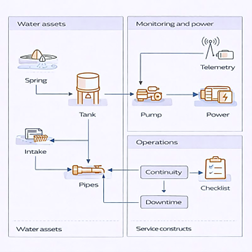
This paper presents an operational conceptual model for choosing between gravity-fed and pump-driven rural water distribution under affordability limits and constrained operator capacity. Decisions in rural WASH planning are often made with incomplete data and fragmented governance, and practical frameworks that map context to testable decision propositions remain limited. The proposed framework defines the unit of analysis as a candidate scheme within a community context and specifies constructs for life cycle cost (LCC), decision-threshold stability, and service continuity, supported by a coding rubric and explicit causal mechanisms. Evaluability is operationalized using grouped and external holdouts, 4 baseline comparators, 3 primary indicators, and BCa 95% confidence intervals from paired bootstrap with 2000 resamples, alongside stress-test ranges that include demand from 30-650 GPCD and inlet turbidity up to 1863 NTU. Empirical performance outcomes are not reported here; the contribution is a transparent decision model with boundary conditions and misuse guardrails intended to support rural water engineers and planners selecting distribution modalities in resource-constrained programs.
Article Details

This work is licensed under a Creative Commons Attribution-ShareAlike 4.0 International License.