Designing Climate Smart WASH Infrastructure for Flood-Prone Rural Areas
Article Sidebar
Main Article Content
Abstract
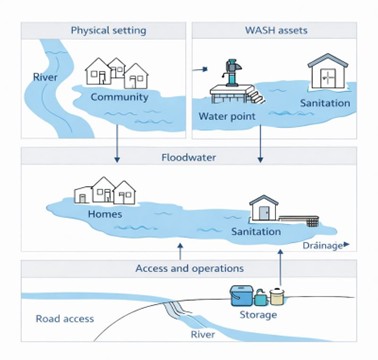
This study presents a conceptual decision framework for flood-resilient rural water, sanitation, and hygiene (WASH) services that links hazard zoning to design packages, governance capacity, and operations and maintenance requirements. Existing practice commonly separates hazard mapping, engineering design, and governance checklists, which limits traceable package selection under sparse monitoring and disrupted access. The framework is derived through theory synthesis and reconciliation of guidance and resilience sources, with inclusion and provenance rules that keep decisions auditable; empirical validation is not reported here. It defines a flood-season service continuity index (0-1) and component metrics for water uptime, sanitation functionality, contamination incidents (per 1000 user-days), and lifecycle cost ratio. Thresholds encode acceptability: Continuity Index >= 0.80 (95% CI), Water Uptime >= 90%, Sanitation Functionality >= 85%, Worst-Slice Continuity >= 0.65, and Lifecycle Cost Ratio <= 1.10. The evaluability plan uses grouped and seasonal holdouts, bootstrap intervals, calibration checks, and halt rules that default to conservative packages when inputs are missing for implementers in flood-prone rural communities.
Article Details

This work is licensed under a Creative Commons Attribution-ShareAlike 4.0 International License.