Evaluating Behaviour Centered Design for Hygiene Promotion in Schools
Article Sidebar
Main Article Content
Abstract
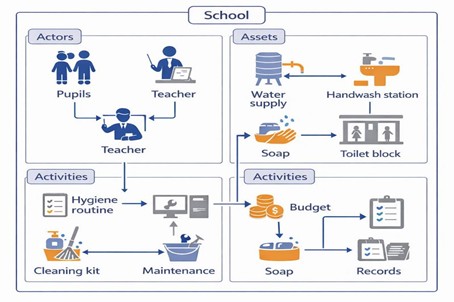
This study presents a behaviour-centered conceptual model for school hygiene programming that treats WASH interventions as constrained decisions linking context, implementation fidelity, and sustained practice. Current choices are often made with incomplete data and fragmented governance, and prevailing program logics frequently emphasize infrastructure or messaging without a clear, testable mapping from context to expected service outcomes. The proposed framework defines term-level constructs for resources and governance capacity, behavioural opportunity and motivation, and delivery fidelity, and operationalizes them through a compact coding rubric and explicit mechanisms that connect constraints to observable performance. Evaluability is embedded through prespecified propositions and a validation blueprint based on grouped and external holdouts, leakage controls, and bootstrap uncertainty reporting, with decision rules requiring Increase >=20 pp in observed handwashing with soap versus baseline, behaviour persistence rate >=70%, and fidelity score >=0.80 with a 95% CI pass. The resulting model and protocol are intended to support structured comparison against logistic regression, causal forest, and infrastructure-only or messaging-only baselines, enabling school administrators and implementers to select feasible hygiene promotion packages under resource and capacity constraints.
Article Details

This work is licensed under a Creative Commons Attribution-ShareAlike 4.0 International License.