
Decentralized Solar Powered Water Purification Systems for Off-Grid Communities
Article Sidebar
Main Article Content
Abstract
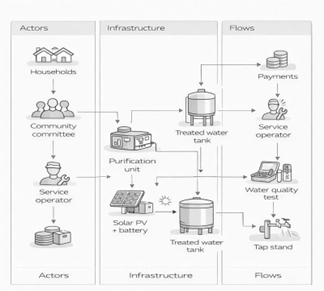
This study presents a practice-oriented conceptual framework to support decentralized, solar-powered water purification decisions for off-grid communities where governance and resource constraints often limit service reliability. Existing technology-centric selection approaches rarely map local context to auditable decisions with measurable service proxies, which makes comparisons across programs inconsistent. The proposed model couples water demand and on-site solar energy supply through a nexus-oriented accounting structure, then operationalizes decision rules against three outcomes: water safety compliance rate proxy, energy balance margin percent, and maintenance feasibility score, with explicit boundary conditions and affordability caps. Evaluability is built in through a programmatic cohort validation plan that uses grouped holdouts by geography and context, baseline comparators (simple scoring, regularized feasibility rules, capital-cost-only selection, and single-technology defaults), and leakage controls via entity-identifier splits. Uncertainty reporting is specified using BCa bootstrap 95% CI with alpha 0.05 and 2000 resamples, complemented by rubric coding checks using two annotators with adjudication on a 15% coded sample and deployment-oriented reporting of runtime minutes per 10k records using median and p95 over 5 runs. The resulting artifact is a compact set of constructs, propositions, and decision thresholds (>=95%, >=20%, and >=0.80, each with a 95% CI) intended to guide service providers and community committees in off-grid WASH programs toward safer and more feasible intervention choices.
Article Details

This work is licensed under a Creative Commons Attribution-ShareAlike 4.0 International License.