
Digital Twins for Urban WASH System Optimization and Resilience Assessment
Article Sidebar
Main Article Content
Abstract
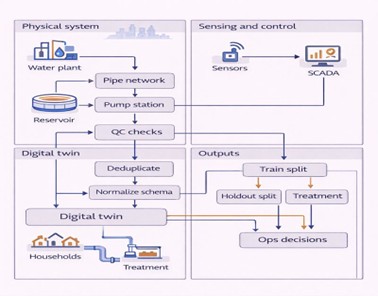
This study presents a decision-oriented conceptual model for urban water, sanitation, and hygiene (WASH) digital twins that support performance and resilience decisions under incomplete data and fragmented governance. The central gap addressed is the absence of an operational model that maps context and governance constraints to decisions through propositions that can be evaluated, rather than asserted. The approach specifies a three-layer architecture (operational state, model, decision), encodes entities and intervention links using a knowledge graph, and fixes constructs through a coding rubric aligned to pressure prediction mae, event detection f1, and decision support uptime percent. A programmatic cohort validation plan is defined using grouped holdouts by entity and context, train-only preprocessing with entity ID leakage audits, baseline comparisons (LSTM, isolation forest, static calibrated hydraulic model, threshold alarm rules), and uncertainty reporting via BCa bootstrap 95% confidence intervals with 2000 resamples; robustness is stress-tested under missing-sensor slices, seasonal drift, and resource and climate constraints. No empirical results are reported here, but the framework provides auditable decision objects and a falsifiable evaluation protocol intended to guide utility operations and asset managers when selecting interventions under affordability and capacity limits.
Article Details

This work is licensed under a Creative Commons Attribution-ShareAlike 4.0 International License.