Public Private Partnerships for Sustainable Urban WASH Infrastructure Development
Article Sidebar
Main Article Content
Abstract
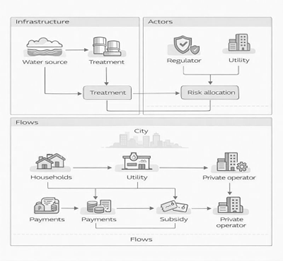
This study presents an operational conceptual model to support urban water, sanitation, and hygiene (WASH) public-private partnerships (PPPs) when contracting decisions must be made under fiscal stress and fragmented governance. Existing PPP lenses often remain descriptive, which limits consistent selection of contract forms and weakens accountability for service reliability, affordability, and equity outcomes. The proposed framework maps urban context to PPP type-context fit through explicit constructs and boundary conditions, and it is paired with a coding rubric and a programmatic cohort specification designed for grouped holdouts across external context groups and baseline comparisons. Evaluability is strengthened by defining affordability as a cost vs cap ratio with pass criteria of <= 1.0, and by requiring uncertainty reporting via BCa bootstrap with 95% confidence intervals. Construct coding is supported by independent review, with 2 annotators and 15% dual coding plus adjudication to limit silent drift. The resulting package converts theory synthesis into testable propositions and auditable decision rules, while retaining clear non-applicability zones where site-specific engineering or procurement detail is required. This decision-oriented framing has direct implications for contracting authorities, regulators, and urban utilities seeking PPP designs that protect affordability and accountability alongside measurable service KPIs.
Article Details

This work is licensed under a Creative Commons Attribution-ShareAlike 4.0 International License.