
Governance and Financing Barriers in Scaling Urban Sanitation Infrastructure
Article Sidebar
Main Article Content
Abstract
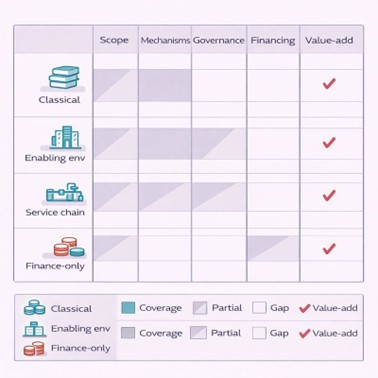
This paper presents an operational conceptual framework that explains why urban sanitation infrastructure scale-up stalls under fragmented governance, constrained finance, and limited monitoring of non-sewered service chains. Existing typologies often reduce the problem to single-cause narratives or generic checklists, leaving decision limits implicit and weakening comparability across cities. The proposed approach defines bounded constructs for governance and financing barriers, links them to causal mechanisms shaping service reliability and equity, and specifies boundary conditions under affordability and operator-capacity constraints. A programmatic cohort design and a structured coding rubric are introduced to convert heterogeneous case material and public aggregate water, sanitation, and hygiene statistics into evaluable indicators, supported by grouped holdouts, leakage controls, and bootstrap uncertainty reporting. The contribution is a compact set of propositions and a validation protocol that makes alternative explanations testable while preserving traceability of evidence and decision rules. The framework is intended to support municipal leaders and sanitation regulators in low- and middle-income cities when selecting feasible remedies under fiscal and institutional constraints.
Article Details

This work is licensed under a Creative Commons Attribution-ShareAlike 4.0 International License.