Social Norms and Peer Influence in Rural Hygiene Behaviour Transformation
Article Sidebar
Main Article Content
Abstract
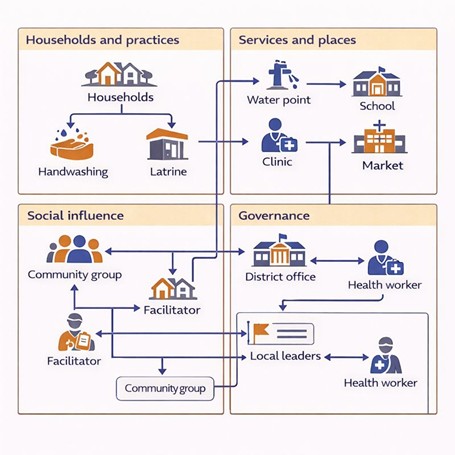
This study presents an operational conceptual model of social norms and peer influence in rural hygiene adoption, aimed at improving intervention choices under WASH governance and resource constraints. Existing accounts often describe norms or diffusion qualitatively, leaving limited guidance on how contextual cues translate into decisions that can be evaluated against measurable service outcomes. The proposed framework links subjective norms, peer networks, attitudes, perceived control, and context constraints to a construct-to-decision mapping and coding rubric, with validation planned on the Rural Hygiene Norms and Diffusion Cohort using grouped holdouts and explicit baselines (logistic regression on survey features, graph and information-only comparators, and generic norms messaging). Evaluability is anchored in inter-rater agreement kappa, taxonomy coverage percent, and mechanism-outcome association via Area Under the Curve (AUC), with acceptance criteria set to greater than 0.75, greater than 85, and greater than 0.70, respectively; two annotators labelled a 15% sample with adjudication. Uncertainty reporting follows a BCa bootstrap with 2000 resamples to produce a 95% confidence interval (CI), and robustness is stress-tested with a degradation flag when primary metric CI overlap <=50%. The resulting package clarifies boundary conditions and failure modes while remaining usable as a decision aid, supporting community facilitators and health workers in selecting norms- and network-informed hygiene interventions under affordability and operator-capacity limits.
Article Details

This work is licensed under a Creative Commons Attribution-ShareAlike 4.0 International License.