AI Driven Predictive Monitoring and Optimization of Decentralized Water Treatment Infrastructure in Resource Constrained Urban Settlements
Article Sidebar
Main Article Content
Abstract
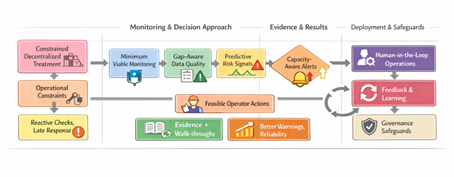
Decentralized drinking water treatment in resource constrained urban settlements often depends on sparse and messy monitoring, which can delay the detection of unsafe or unreliable operation. Reactive checks and fixed thresholds may miss early warning signals and can contribute to alarm fatigue when data are intermittent. A practice-oriented framework is presented that converts low-cost sensor streams, sparse operator logs, and occasional lab results into short horizon forecasts, anomaly scores, and soft sensor estimates, and then links these outputs to human in the loop decisions for real-world use. The architecture is organized as staged sensing and logging, data quality checks and gap handling, predictive monitoring, a decision layer with persistence and capacity aware escalation rules, an action layer, and feedback logging to support threshold tuning and model update triggers. Transferability is bounded to the evaluated setting, and the scope excludes autonomous closed loop control and benchmark heavy comparisons, while prioritizing safeguards for missing data, sensor drift, and conflicting signals. The resulting monitoring to action protocol is implementation grounded and intended for WASH operators, supervisors, and dispatch teams in low-income urban settings.
Article Details

This work is licensed under a Creative Commons Attribution-ShareAlike 4.0 International License.